
Beginner Golfers: Beginner Golf Swing Tips

Beginner golfers often struggle with the game of golf because they tend to over-complicate the swing.  What compounds this problem is that there are way too numerous golf instructional approaches that basically communicate the same things, but contain nuances that confuse the beginner golfer.  What follows is a quick primer of beginner golf swing tips intended for the beginner golfer to begin to learn the fundamentals of the golf swing.

Learning Golf Swing Basics: The Four Phases of the Game

Before we get into beginner golf swing tips, it is important to realize that there are four related, but distinct phases of the golf game and the golf swing fundamentals within each phase builds upon one another.

The first phase of the golf game is the “distance” game which for our purposes we will define as golf shots 200 yards or longer. These shots are typically hit with the woods (driver, 3 wood, etc.) or long irons (1-iron, 2-iron, hybrid).

The second phase of the golf game is the “mid-range” phase which is for golf shots that occur after distance shots and typically range from 130 to 200 yards.

The third phase is the “short game” phase which is typically for shots toward the green from 130 yards and in.

The fourth phase is the “putting” phase which is for shots that occur on the putting surface toward the golf cup.

For many beginner golfers, it is often best to “start small” and learn golf swing basics starting with the fourth phase (putting) and move back through each phase ending with the first phase (distance game). The advantages of this approach is that 1.)the golfer can build solid golf short game fundamentals in phases four and three which also serve as the foundation for the full golf swing in phases two and one and 2.) the short game typically accounts for over 60% of the golf score, so the quicker the beginner golfer has a handle on the short game, the faster he or she will achieve lower scores.

Beginner Golf Swing Tips

For the beginner golfer, what follows is a set of beginner golf swing tips to properly setup and execute the key shots necessary for each phase:

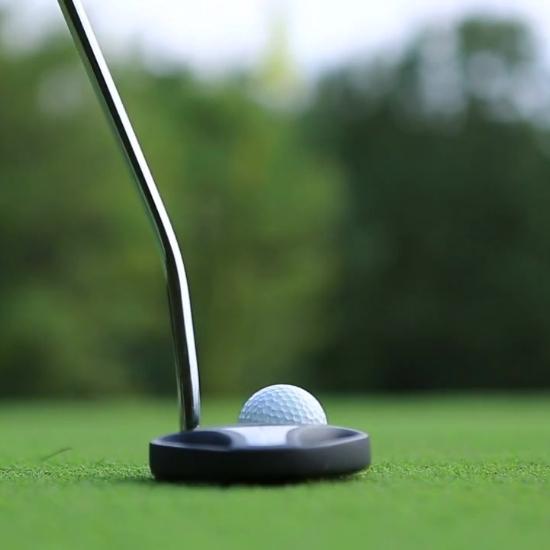
Phase 4: Putting Golf Swing Tips

  • Key to putting setup is comfort over the ball, light grip tension and no breakdown in stroke.
  • Ensure that eyes are directly over the ball.
  • Use steady, pendulum-like tempo and accelerate through follow-through.
  • Keep lower body “quiet” throughout stroke.

Phase 3: Short Game Golf Swing Tips (Pitch Shot and Chip Shot)

Pitch Shot Golf Swing Tips

  • The “pitch shot” spends more time in the air than on ground and is typically used for shots that range from 10 to 70 yards from the cup. Use lofted club—sand wedge (54-58°) or lob wedge (59-62°).
  • Grip firmer
  • Slightly open your stance.
  • Position yourself that the golf ball is slightly forward from the middle of your stance.
  • Place and leave 60% of your body weight on your left leg throughout the shot.  This promotes a descending blow on the golf ball which is needed for a crisp pitch shot.
  • Move hands down the grip and in front of the ball.
  • Keep steady pace and move your torso back and through the shot.

Chip Shot Golf Swing Tips

  • The “chip shot” is used to land the ball on the green as quickly as possible and is typically executed when you are 3 to 6 feet from the green.
  • Place 60% to 70% of your weight on left leg throughout shot.
  • Open your stance.
  • Position yourself so that the ball is just right of center or back in your stance.
  • Place your hands down on the grip and in front of ball.
  • Maintain a smooth, easy stroke…do not let left wrist break throughout the shot.

Phase 2: Mid-Range Game and Phase 1: Distance Game Golf Swing Tips

Phases 2 and 1 should both follow the same basic swing fundamentals with one exception –golf ball position. The position of the golf ball dictates whether you make contact with the golf ball at the bottom of your golf swing arc (descending swing that hits “down on the ball”) or as your golf swing arc starts to ascend just after the bottom of your swing arc (ascending swing that hits the ball on the “upswing”).  Basically, you want to hit down on the ball in your iron shots and on the upswing with your woods off the tee.

Golf Ball Position Golf Swing Tips

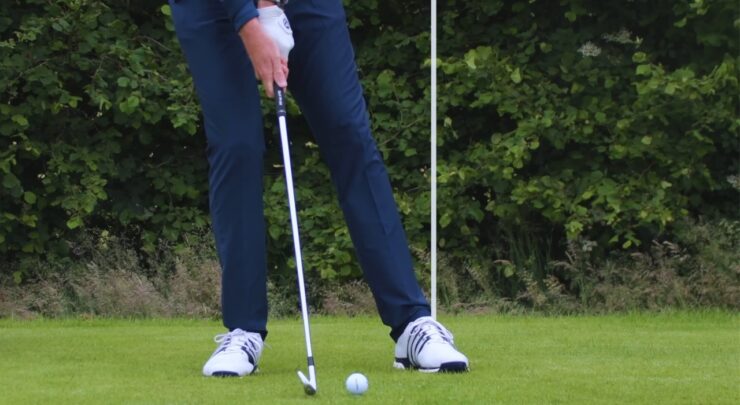
To hit downward on the ball to hit crisp iron shots, position yourself so that the golf ball is:

  • In the center of your stance for 8, 9 irons and wedges
  • One golf ball forward from center for 5, 6, and 7 irons
  • Two golf balls forward from center for 3 and 5 woods and hybrid clubs
  • Three golf balls forward from center for driver shots

Backswing Golf Swing Tips

  • Assume address position
  • Rotate club, body and arms back along your golf swing plane while shifting your body weight to the inside of your right leg.
  • As hands approach waist, wrists should hinge.
  • At the top of the backswing, check that left arm is straight, 80% of body weight is on inside of right leg and right knee is flexed.
  • Check that your shoulders are turned 90° and hips are turned 30 to 45°

Downswing Golf Swing Tips

  • First movement of downswing is weight shift to the left, then hips, arms and shoulders unwind to impact.
  • At impact, club is released by unhinging wrists and delivering club head square through ball – keep head behind ball at impact.
  • As body turns to target through golf swing impact, arms and clubs extend down the target line.
  • At finish position, belt buckle faces target; club is wrapped around shoulder; 90% of weight is on left leg with right foot upright on toes.

Practice these beginner golf swing tips regularly and you will soon have a strong feeling (and fever) for the game!

Posted in Full Swing Tips | Tagged , , , , , , , , , , , , , , , , | Comments Off

BASIC GOLF TIPS FOR SOLID DRIVER SHOTS

Common Ball Flights from Golf Genie Tee to Green Pocket Guide

Many golfers are intimidated by driver shots and in an effort to “drive for show” lose focus of driver shot fundamentals forgetting to simply let the driver do the work for them. Remember, it is much, much better to hit a straight 200 yard drive into the fairway than a 300 slice into the woods.

With that said, here are a few basic golf tips to setup properly for driver shots which will result in both more accuracy and longer distance.

  • Ball position golf basics – Though you should hit downward on the ball to hit crisp iron shots, the driver shot should ascend with a goal to make contact with the ball as the driver club head moves upward. To promote this ascending swing, the ball must be placed forward in the stance.  A good driver basic golf tip is that the ball is aligned with the heel of the left foot (approximately three balls left of center for right handers).
  • Posture and stance golf basics – Take a slightly wider than shoulder-width stance and tilt from hips until spine/back angle is approximately 30 degrees from straight position.
  • Backswing golf basics – When making backswing, large muscles of torso should wind up like a spring as you turn against right knee. ”Lock” right knee in place at same angle as address.
  • Downswing golf basics – To start downswing, shift weight to left, triggering chain reaction of hips, chest, arms and club all pulling behind the ball. At impact, try to keep the head behind the ball as this helps maintain your swing plane and promotes ascending swing arc through ball contact. It is especially important to keep your left arm straight from impact through release and avoid the dreaded left elbow breakdown (or “chicken wing”) which causes a host of errant shots.

A great practice drill for driver shots is the “whoosh” drill which can be practiced on the range or between shots on the course.  Here are basic golf tips to execute the whoosh drill:

  1. Flip driver upside down and grip shaft just above club head.
  2. Make normal swing with driver and listen for “whoosh” sound from shaft on the downswing.
  3. The whoosh sound should be heard after “impact” resulting from proper extension and acceleration through ball.

Practice the drill until whoosh sound is heard after point of impact. Carry over this sensation to full swing for more distance with driver shots.

Posted in Full Swing Tips | Tagged , , , , , , , , , , , , , , , , , | Comments Off

Fun interview with “Where to Play Golf”

Had a great time with Michael Stewart and the hilarious guys at “Where to Play Golf” discussing Golf Genie products. Click this link for the interview.

http://bit.ly/wheretoplaygolf

Posted in Media Interviews | Tagged , , , , , , , , , , , , , , , | Comments Off

Great Review of Practice Drills Pocket Guide!

Greg D’Andrea from the wildly popular blog “Golfstinks” just posted this great review of the Golf Practice Drills Pocket Guide.  We really like the Golfstinks blog because it shares our philosophy of simplifying and having more fun with the game!

Here is a link to the review or you can see the full text below:

http://golfstinks.blogspot.com/2011/02/genius-continues-golf-genie-practice.html

The Genius Continues: Golf Genie Practice Drills

When I was playing golf wretchedly competitively on my high school team, we used to practice every day of the week. Drills, drills and more drills. And then walk 9 holes. I have two points to make on that:

First, I always needed a reminder on how do the drills. I mean, I remembered two or three of them, but I would always forget the rest (and there were a bunch). Second, for some reason (perhaps it was the omnipotent teenager in me), I never thought to stretch. On that later point:

The summer after my senior year (golf season had just ended) my sciatic nerve decided to incapacitate me for two weeks straight. I couldn’t drive (mainly because I couldn’t get in the car), or even walk really. And I certainly couldn’t golf…for like two months! I blame the whole ordeal on not stretching before teeing-off on the first hole.

Nearly 19 years later, I received the one product that would have solved both my problems: The Golf Genie Practice Drills Pocket Guide. The first four pages? Pre-swing stretches. The rest of the book? All the golf drills you could possibly imagine – all in one place and conveniently located right in your golf bag.

I’ll tell you what; I like this Golf Genie company. Last summer, I had nothing but praise for its Tee to Green Pocket Guide; “a practical, quick reference guide to pulling-off all the different golf shots you may encounter out on the course.”

The Practice Drills Pocket Guide, the company’s second offering, is the perfect compliment to the Tee to Green Pocket Guide. Packed with more than 60 pages of stretches and drills, this guide will get you prepared for your round, tournament or just a Nassau with your golf buddies.

Not playing golf today? Even better – the Practice Drills Pocket Guide features plenty of golf practice routines that can be performed at home, at the range or on the putting green. And perhaps my favorite; There’s a quick guide for 45-, 30-, 15- and 5-minute pre-round routines that can get your muscles an mind focused on the task at hand (of course, knowing how late I show up at the course, I’ll probably only have time for the 5-minute routine)!

As with the Tee to Green Pocket Guide, the Practice Drills Pocket Guide is easy to use. Each drill features a few numbered steps with simple and fun diagrams to get you going through the proper motions in seconds flat. No gimmicks or gadgets – just “PGA-proven” drills that were contributed by top PGA instructors.

Ready to add one to your golf bag? The Golf Genie Practice Drills Pocket Guide retails for $15 in pro-shops all over the country or at golfhelptips.com. But in preparation for the upcoming season, we’ll be giving away 25 for free! Yep – five Practice Drills Pocket Guides a week for the next five weeks – all through our Facebook page. What do you have to do to get one? Just become a fan and wish yourself luck, because we’ll be choosing the winners at random!

Good luck Golfstinks fans! And remember: Practice makes perfect (or at least less wretched).

Posted in Golf Genie Reviews | Tagged , , , , , , , , , , , , , , , , , , , , , , , | Comments Off

“LAST MINUTE” GOLF TIPS

In today’s hectic world, it is getting harder and harder to find the time to hone your golf game whether on the driving range or on the course.  It’s difficult enough to find 2 to 5 continuous hours to work in 9 to 18 holes.  But what do you do when you only have a few minutes to practice or prepare for your round? For the busy golfer, here are a few last minute golf tips that can really help your game in very little time on the range or before your round.

On the Range

First, to get the most out of your limited time when you practice, make sure you spend a few minutes to define your practice agenda, needs and focus areas before you practice.  In other words, practice with a purpose!

Second, it is critical to realize that sixty percent or more of your golf score occurs within 100 yards of the hole. Here’s a quick golf tip – to most efficiently lower your golf scores, devote half or more of your limited time practicing the short game (pitching, chipping and putting).

Here is a last minute golf tip 30 minute routine for the range designed for efficient practice.

  • 5 Minutes: Pre-swing warm up (stretching and quarter-speed swings)
  • 5 Minutes: Hit short chip/pitch shots
  • 5 Minutes: Hit full pitch shots 30 to 60 yards
  • 10 Minutes:  Full swing – alternate among irons ( 9-iron, 7-iron, 5-iron) and Driver
  • 5 Minutes: Short, mid-range and long putts

Pre-Round

If you have 15 minutes or less before your round, here are two last minute golf practice routines to help you play your best.

  • 5 Minutes: Pre-swing warm up (stretching and quarter-speed swings)
  • 3 Minutes: Putt on practice putting green at 30, 9, 3 foot distances with goal of getting “feel” of green speeds
  • 5 Minutes: Hit 7-iron shots – 3 at half speed and 3 at full speed
  • 2 Minutes:  Hit 3 to 4 driver shots with emphasis on rhythmic, fluid swing.
  • Relax on the tee box – take deep breaths and enjoy the scenery!

If you have 5 minutes or less to practice, the most critical thing to do and remember is stretch before your round and relax as much as possible.

Though these last minute golf tips are relatively simple, they can go a long way to help you play your best golf when you are time constrained.  Happy golfing!

Posted in Tee to Green Golf Tips | Tagged , , , , , , , , , , , , , , , , | Comments Off

Setting Up and Executing Golf Pitch and Chip Shots

pitch shot, how to play pitch shot, golf genie pitch shot, golf genie, golf pitch shot, pitching the ball

Page 20: Golf Genie Tee to Green Pocket Guide

Over 60% of your golf score can be attributed to the short game and the degree that you can successfully execute the golf pitching shot and golf chipping shot is critical to improving your score.  To help you get the most out of your short game on or off the course, here are some critical golf pitching and chipping shot tips to become a short game master.

Golf Pitching Shot: Setup and Execution

  1. The “golf pitching shot” is typically used for distances from ten to seventy yards.
  2. The golf pitching shot spends more time in the air than on the ground.  When hitting golf pitching shots, use a lofted club such as a sand wedge (54 to 58 degrees loft) or lob wedge (59 to 62 degrees loft).
  3. Slightly open stance.
  4. Ensure that your ball position is slightly forward from the middle.
  5. Place your weight so that sixty percent of your weight is on your left foot and 40 percent is on your right foot. Keep this weight distribution throughout the golf pitching shot.
  6. Move hands down the grip and in front of the ball.  Grip the club slightly firmer in the golf pitching shot than you would for a normal golf shot.
  7. Keep steady pace and swing torso back and through the golf pitching shot.
  8. To control your distance, use the 7-8-9 golf pitching shot method where you swing your straight left arm back to the particular “hours” of a clock to achieve consistent distance control.  For example, if you swing your left arm back to the “9-o’clock” position and hit the ball 45 yards, then your 9 o’clock shot is for 45 yard golf pitching shots.  Practice this approach until you know your distance for “7 o’clock,” “8 o’clock” and “9 o’clock” shots.

Golf Chipping Shot: Setup and Execution

  1. The “golf chipping shot” is typically used when your ball is 3 to 6 feet off the putting surface.
  2. The golf chipping shot is used to land the ball onto the green as soon as possible toward the cup.
  3. When setting up for the golf chipping shot, distribute your weight so that 60 percent of your weight is on your left leg throughout the chip shot.
  4. Open your stance.
  5. Position yourself so that your ball position is right of center.
  6. Place your hands down the grip and in front of the ball.
  7. Make a smooth, easy stroke…do not let the left wrist brick in the golf chipping shot.
  8. Maintain the letter “Y” that is formed with your hands, arms and shoulders throughout the golf chipping shot stroke.

Practice these quick golf tips for the golf pitching and chipping shot regularly and watch your short game improve dramatically while your scores drop. All the golf practice drills are designed by pro PGA instructor.

Posted in Tee to Green Golf Tips | Tagged , , , , , , , , , , , , , , , , , , , , , , , , , | Comments Off

Playing the Golf Bunker Shot

Hitting Bunker shots, bunker shots, greenside bunker, bunker shot tips, bunker shot setup, how to hit bunker shot, hitting in sand, sand shots

Page 17 from Tee to Green Pocket Guide

Most golfers recoil in disgust when their ball lands in either fairway bunkers or greenside bunkers.  On any given day, you will see countless golfers hacking away in the sand in a desperate attempt to get the ball airborne.  However, the golf bunker shot is really not that difficult to execute.  The problem is that golfers do not know how to set up properly for golf bunkers and they rarely get a chance to practice golf bunker shots.  Though we cannot execute the golf bunker shot for you, here are some quick golf tips to help successfully execute golf bunker shots. Note: the following golf bunker shot tips are for right handed golfers.

Greenside Golf Bunker Shot

  1. Use a sand wedge – open the clubface and open your stance with the clubface facing the target.  Notice the type of sand you are playing out of by feeling it with your feet (PGA rules do not allow you to “ground” your club in the sand before taking a golf bunker shot.) The softer the sand, the more “open” you position your clubface.
  2. Place 60% of weight on the left leg and leave it there throughout the golf bunker shot.
  3. Position your stance in the golf bunker so that the golf ball is forward in your stance.
  4. When taking the golf bunker shot, hit the sand 2 inches behind the ball.  It is critical keep your left arm straight throughout the golf bunker shot and control the shot by rotating the body, not the arms, through the shot.

Fairway Golf Bunker Shot

  1. Grip down on club 1 inch. Take one more club than usual (i.e., a 5-iron for a 6-iron shot) and swing smoother.
  2. Distribute weight evenly at address.
  3. Position body so that ball is in the middle of stance.
  4. Stand taller at address to avoid striking the sand first.
  5. Make sure to strike the ball cleanly from the sand.

Of course, your golf bunker shot game will improve with practice, but at a minimum, memorize these golf bunker shot tips and you will see your fear of golf bunker shots fade away. Bring all these golf practice drills in your daily practice routines to lower your golf score.

Posted in Tee to Green Golf Tips | Tagged , , , , , , , , , , , , , , , , , , | Comments Off

GOLF SWING INSTRUCTION AND TIPS FOR BEGINNERS

full golf swing, full swing alignment, full swing setup, golf shot basics, the swing plane, golf swing, golf basics, full swing plane, how to play golf

Pages 9 and 10 from Golf Genie Practice Drills Pocket Guide

Beginner golfers learning the game of golf should focus their efforts on the most critical elements of the golf swing, namely the golf grip, setup and full swing fundamentals.  Here are golf swing basics and tips that reinforce these fundamentals.  Note: these golf swing tips are for right handed golfers.

The Grip

  1. For most golfers, the recommended golf grip for the golf swing is the Vardon Overlap grip where the little finger of the right hand (trailing hand) is placed in the crease of the forefinger and middle finger of the left hand (leading hand).
  2. The left hand thumb should fit in the lifeline of the right hand.
  3. The finished golf swing grip should lie in fingers and not the palms.
  4. Grip pressure determines amount of wrist hinge and release – on a scale of 1 to 10 where 10 is “tight” and 1 is “loose,” strive for a “5 to 6.”
  5. “Neutral” grip is recommended for majority of golf swing shots and results in “square” clubface at impact. Using a neutral grip, the “V” formed by thumb and index finger of each hand should point between right shoulder and chin.

Golf Swing Posture & Stance

  1. Body weight in middle of feet.
  2. Tilt from hips approximately 30 degrees to achieve proper spine angle.
  3. Knees slightly flexed.
  4. Keep back straight. Visualize an “axis line” down spine. Rotate around this axis line throughout the golf swing.
  5. Arms hang freely.
  6. Chin up and off chest.
  7. Stance: shoulder-width for mid-irons; slightly wider for longer irons and woods; slightly narrower for shorter irons and wedges.

Full Golf Swing Fundamentals

Backswing

  • Assume address position
  • Rotate club, body and arms back along your golf swing plane while shifting your body weight to the inside of your right leg.
  • As hands approach waist, wrists should hinge.
  • At the top of the backswing, check that left arm is straight, 80% of body weight is on inside of right leg and right knee is flexed.
  • Check that your shoulders are turned 90° and hips are turned 30 to 45°

Downswing

  • First movement of downswing is weight shift to the left, then hips, arms and shoulders unwind to impact.
  • At impact, club is released by unhinging wrists and delivering club head square through ball – keep head behind ball at impact.
  • AS body turns to target through golf swing impact, arms and clubs extend down the target line.
  • At finish position, belt buckle faces target; club is wrapped around shoulder; 90% of weight is on left leg with right foot upright on toes.
Posted in Full Swing Tips | Tagged , , , , , , , , , , , , , , , , , , | Comments Off

Golf Putting Basic Tips

Golf putting, putting basics, putting tips, basic putting instructions, putting help, putting greens, reading greens

Pages 28 and 29 from Golf Genie Tee to Green Pocket Guide

Putting can account for 50% or more of your golf score.  So, it is critical to master golf putting basics to achieve your scoring goals.  Here are some key golf putting tips to improve your golf putting distance control, speed and accuracy. Note: the following golf practice drills for putting are for right handed golfers.

Golf Putting Stroke Setup

  1. Setup with the ball just left of center with eyes over the ball and head steady.
  2. The golf putting stroke should have a consistent backswing length and follow-through.  Keep the lower body “quiet” throughout the golf putting stroke.
  3. Use the shoulders with rocking pendulum action and steady tempo throughout the golf putting stroke.

Golf Putting Distance Control

  1. Proper distance control is the most important aspect of putting.
  2. The key to avoiding a “3-putt” is to hit the first putt the correct distance.
  3. Look at the cup as an intermediate target – aim 9 to 18 inches past the cup.
  4. Avoid hitting short of the cup or below the cup.

Reading Greens: Breaks

  1. On the golf putting surface, examine the green and look for the lowest and highest points.
  2. The ball will break toward the lowest point – the more severe the “low” the more severe the break.
  3. Aim putt toward the top of the break rather than the cup.
  4. When in doubt, play more break.
  5. Ball tends to break toward water – if lake is nearby, expect the ball to break toward it.

Reading Greens: Grass

  1. Consider the grain and direction of the grass. Where grass looks darker, the grain will be “against you” and the putt will be slower; where grass looks shiny, the grain will be “with you” and the putt will be faster.
  2. Greens are typically faster earlier in the day when the greens are cut and slower at end of days as the grass grows.

Golf Putting Drills

  • Golf Putting Circle Drill
    • Place a few golf balls four feet from cup and work your way around.
    • Hole each ball moving clockwise
    • If you miss a putt, start again.
    • Once you hole all putts, move balls further back.
    • Golf Putting Alignment and Stroke Drill
      • Line up two clubs just wider than putter; practice 6-foot putts
      • Train putting stroke to go back and forward, straight and square
      • Maintain smooth pendulum stroke back and forward with steady tempo.
Posted in Short Game Tips | Tagged , , , , , , , , , , , , , , , , , , , , , | Comments Off

Golf Slice Tips: Golf Slice Causes and Fixes

Fix slice, how to fix slice, stop slicing the golf ball, slice fault, slice fix, causes of golf slice, golf slice

Pages 56 and 57 of Golf Genie Tee to Green Pocket Guide

The golf slice is one of the most common swing faults.  The golf slice most commonly occurs when the clubface is open relative to the swing path and/or when the swing follows an “out to in” or “over the top” swing path.  To fix the golf slice, here are the common faults that cause the golf slice and quick tips to fix the golf slice.

What Causes the Golf Slice

The golf slice is a shot that starts left, but finishes right of target, often far right.  The golf slice is one of the most detested golf swing faults in golf because it often results in a very poor position for the next shot and is not easy to fix.  The reason that the golf slice is not an easy to fix golf swing fault is that it can result from several different swing faults which will need to be addressed.

Typical causes of the golf slice include one or of the following – poor body alignment; weak grip; open club face; and/or out-to-in swing path. One or all of these swing faults can contribute to a golf slice.  For instance:

  • Your body is aligned too far left of the target (which may cause you to swing the club from out to in or “over the top” causing the golf ball to start left, but spin far right after impact – due to clockwise spin imparted on ball).
  • Irrespective of body alignment, you swing path can be out-to-in or worse, out-to-in with an open clubface again starting the ball left but spinning it far right.
  • Your grip could be too “weak” which means your grip position is left of neutral which tends to open the clubface.  If everything else is correct in your golf swing and you have a weak golf grip, then you may simply push the ball to the right of the target – not a big deal.  But combined with improper alignment or swing path, an open club face can result in a killer slice.

How to Fix the Golf Slice

So how do you fix your golf slice? For some, one or two adjustments is all that is needed.  For others, it will be a process of elimination.  What is clear, however, is that your ability to fix the golf slice is greatly enhanced if you execute the following golf slice fixes.

  1. Align parallel to the target line. To help visualize, think of standing on a railway line where the ball is placed on the furthest rail (the “target line”) and your body is set up parallel to the target line along the closest rail (the “body line”).
  2. “Strengthen” your grip to a neutral position with a square clubface.
  3. Take a slow motion practice swing and ensure that your swing path is not “over the top” or out to in, but rather down the target line toward the target.
  4. Check your impact position and make sure that your clubface is square at impact.

Perform a few slow motion practice swings with the above golf slice fixes in mind until the proper movements feel natural.  Then hit a few half swing golf shots building up to a full, fluid swing.  If you practice golf and ingrain these fundamentals, your golf slice will be history.

Posted in Problem Swing Tips | Tagged , , , , , , , , , , , , , , , , , , | Comments Off